
What we lose when a traditional craft disappears and why it matters more than we think.
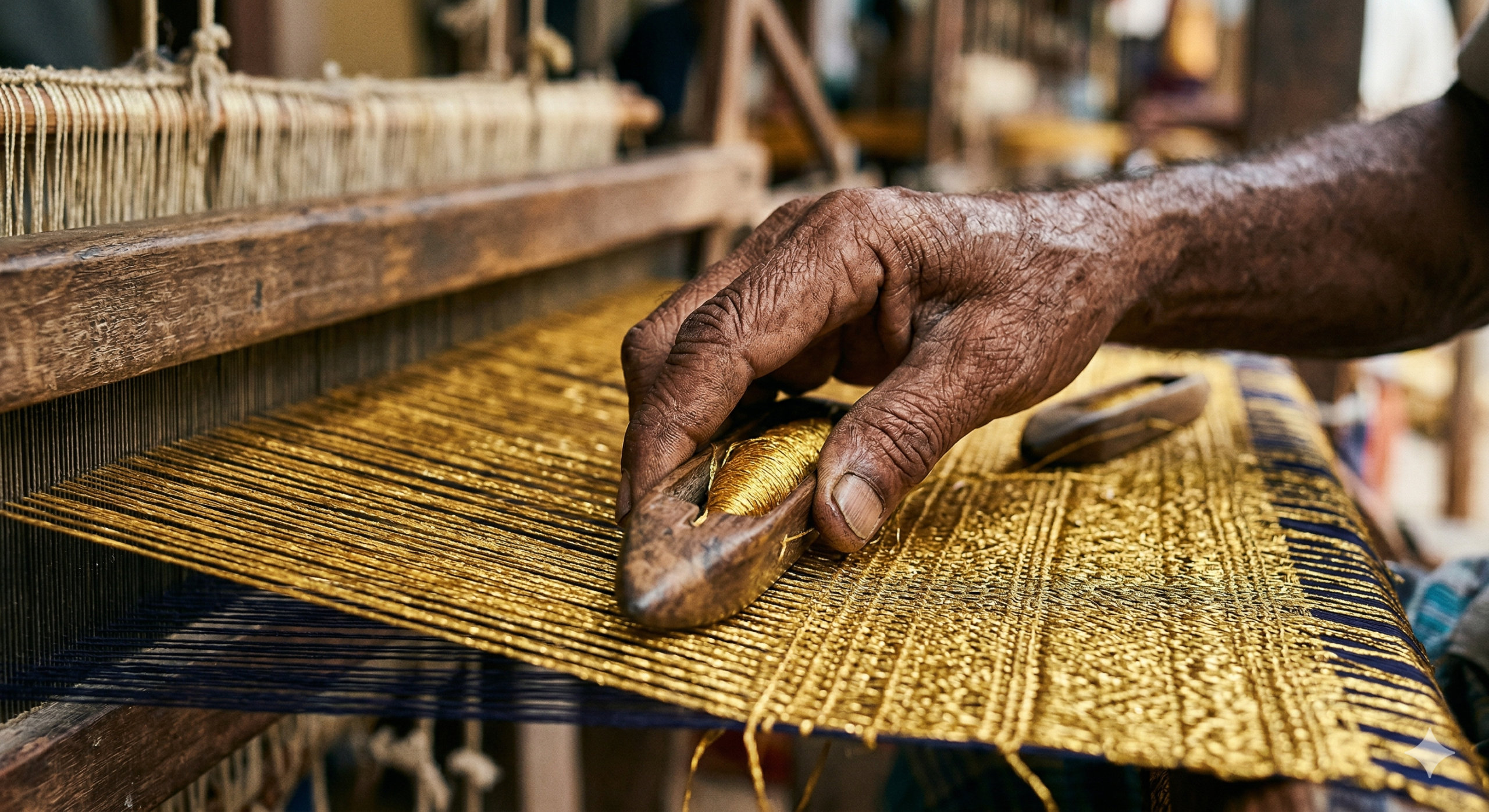
There is a particular weight to a Banarasi saree that has nothing to do with the silk. You feel it the moment someone places one in your hands the quiet authority of something that took weeks to exist, and decades to learn how to make.
The Man Behind the Fabric
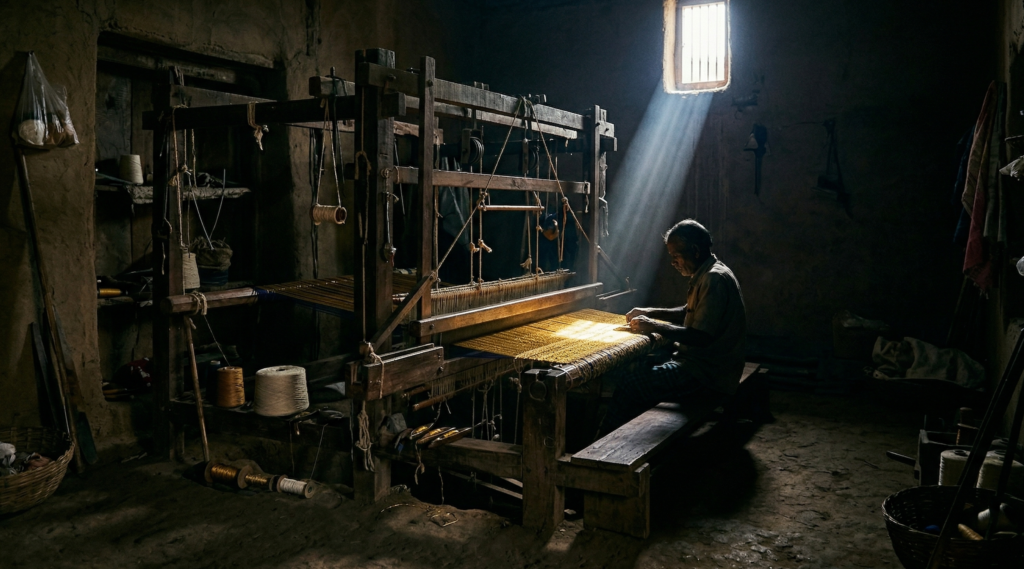
Somewhere in a narrow lane in Varanasi, a man named Rauf sits at a loom that his father sat at before him. He does not think of what he makes as art. He thinks of it as work. But his work, the slow interlocking of silk and zari, the careful counting of warp threads, the reading of a naksha pattern that lives only in his hands and his memory cannot be rushed. It cannot be replicated. And it is becoming increasingly difficult to pass on.
What Makes a Banarasi Different
A single Banarasi saree, made the traditional way, can take anywhere from fifteen days to six months to complete. Real zari is silver wire wrapped in gold. Weavers work it into the fabric in patterns that once indicated which family made it, which part of Varanasi it came from, and which generation of knowledge it carried.
The motifs have names. The techniques have lineages. Banarasi weaving is not embellishment, it is a textile language that developed over five hundred years. And unlike a written language, it lives entirely in the people who still practice it.
Did You Know: The naksha , the pattern card that guides a Banarasi weaver is designed entirely by hand before a single thread is laid. On complex designs, making the naksha alone can take weeks. While the final saree gets all the attention, the naksha is where the real design knowledge lives. When a weaving family stops, these cards are often lost forever.
Why the Craft Is Shrinking
Fewer weavers practice this work every year. However, the reasons are not mysterious.
A powerloom produces in hours what a handloom weaver takes weeks to complete. Machine made imitations flood the market at a fraction of the cost. Although they are almost indistinguishable to an untrained eye, they carry none of the knowledge. Because imitations are cheaper and faster, younger members of weaving families leave for cities, for construction work, for anything that pays more reliably than waiting for an order that may not come.
The loom stays. The knowledge does not always follow.
What Disappears With a Craft
What we lose when a weave goes quiet is not just a technique. It is a way of seeing, a specific understanding of how cloth can carry culture, memory, and place all at once.
When Rauf makes a saree, it holds the geography of a city, the muscle memory of a family, and the accumulated decisions of every weaver who refined that pattern before him. A powerloom copies the surface. It cannot copy the depth.
This is what we rarely think about when we choose the less expensive version. Not the ethics, not the economics, just the depth. The thing that makes a piece of cloth feel, inexplicably, like it means something.
Since that depth lives only in human hands, it cannot be retrieved once it is gone. Some things, once quiet, do not come back.
From Vuna – Where Threads Tell Time
Leave a Reply