
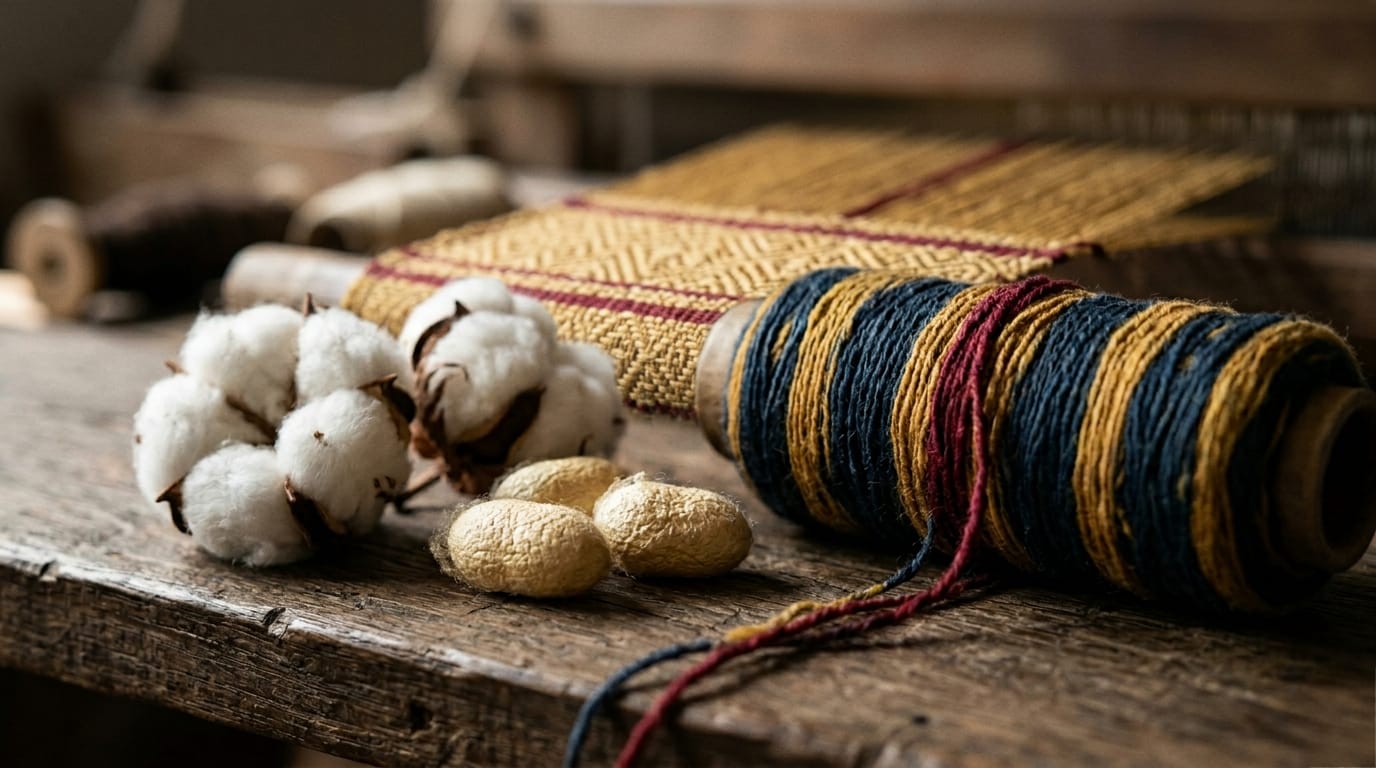
From cotton field to weaver’s loom: The hidden journey inside every piece of Indian handloom, told plainly for the first time.
There is a moment when you touch a piece of fabric and something goes quiet. It isn’t about being loud or shiny; it’s about a textile that feels like it has been somewhere. That feeling has a beginning, and it starts long before the fabric reaches a store shelf.
The Meditative Spirit of the Charkha
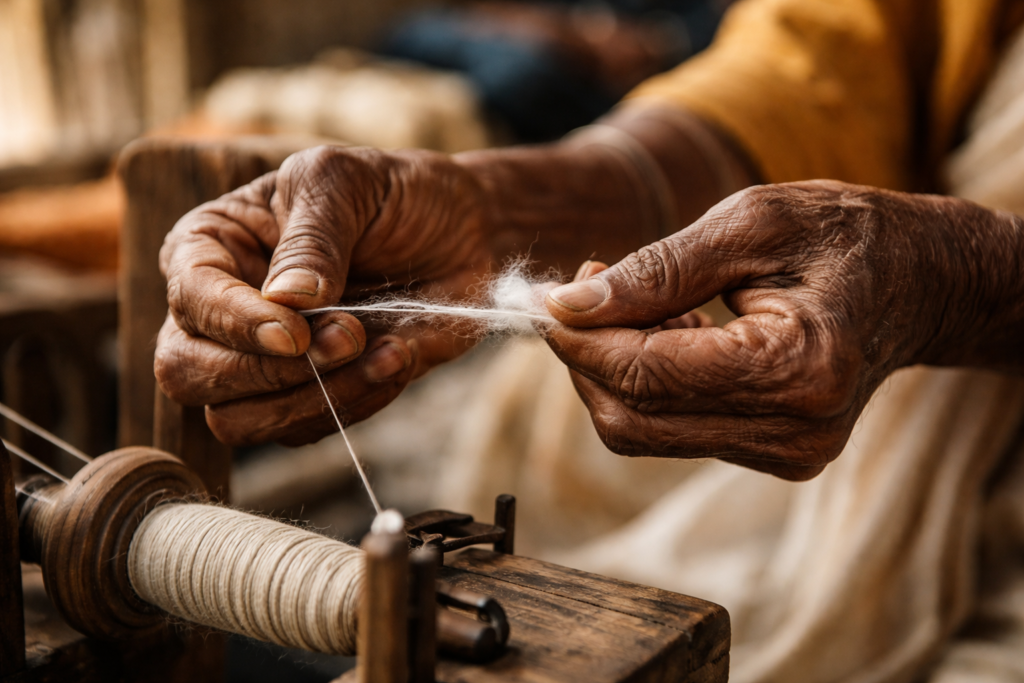
Once harvested, artisans clean and transform raw fiber into yarn—frequently by hand on a charkha. Specifically, this is the same iconic spinning wheel that defined a revolution. While a machine can spin yarn in cold, mechanical minutes, it simply cannot feel.
Furthermore, it cannot adjust tension when the cotton runs coarse or slow down when the silk requires gentleness. In contrast, the intelligence of the spinner lives in the thread long before the weaving begins. This is why handloom fabric falls differently on the body; consequently, the human decision is already woven into its DNA.
Did You Know?
Unlike high-speed industrial spinning, yarn spun on a Charkha retains the natural “air pockets” within the cotton fiber. This makes handspun fabric uniquely “climatized”—it stays cool in the blistering Indian summer and provides surprising insulation during the winter.
Alchemy from the Earth: Colors That Breathe
Before the yarn meets the loom, it is baptized in color. India’s heritage natural dye traditions have thrived for millennia:
- Indigo: Fermented over days to produce a “living” blue that deepens with age.
- Madder Root: Yields a visceral, rich rust red.
- Turmeric: Offers a warm, golden glow that synthetic dyes can never replicate.
Each dye lot is a thumbprint of the season, the water, and the soil. These variations aren’t flaws—they are the physical proof that something real was created here.
Did You Know?
Natural Indigo isn’t just a color; it’s an ancient skin-care secret. Historically, Indigo was prized for its antiseptic and skin-soothing properties. When you wear a naturally dyed Vuna piece, you aren’t just wearing a hue; you’re wearing a fabric that treats your skin with kindness
The Architecture of Patience: One Weaver, One Loom
Finally, the weaving begins. Whether it’s a simple pit loom or a complex frame, what matters is the artisan. Warp and weft cross thousands of times, one careful shuttle throw at a time.
Consider a Banarasi saree with a dense brocade pattern. It takes four to six weeks of patient mornings to complete. In the world of Vuna, time is not a “cost of production”—the time is the product.
What You Are Really Holding
When you drape a handloom piece, you are holding every ghost of this journey:
- The sun-drenched cotton field.
- The silkworm’s silk cocoon.
- The rhythm of the charkha.
- The weeks of silent endurance at the loom.
Most of us were handed a finished piece and a price tag, but nobody connected the price to the process. Now you know. When you notice a slight irregularity in the weave, remember: It is not a flaw. It is a fingerprint. It is the signature of a human hand.
The Story Continues
Knowing how fabric is made is only the first step. The next question arrives naturally: How do you know if it was made well? That is exactly where we go next.
Leave a Reply