
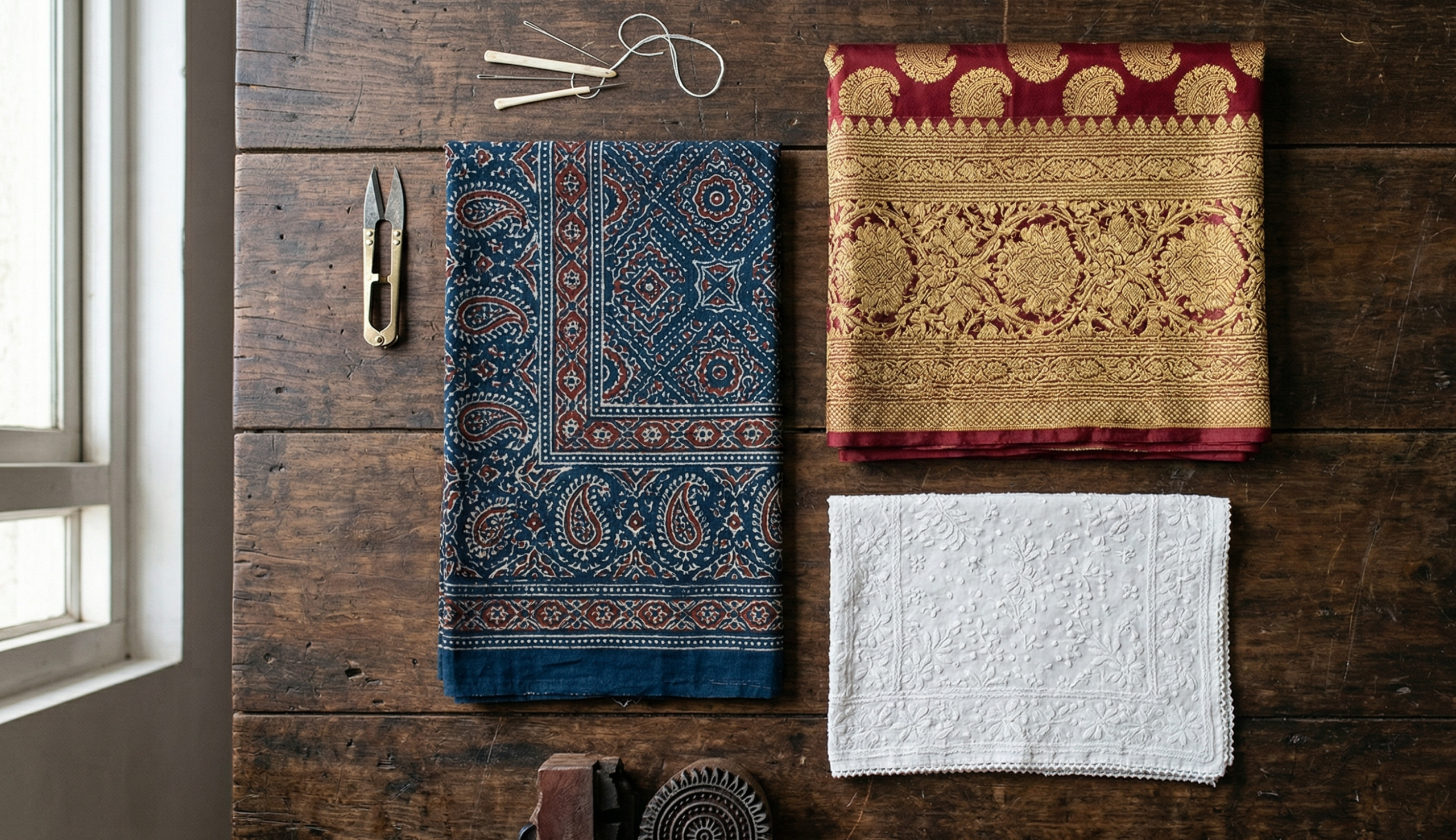
Three crafts. Three corners of India. One thing in common, they were never just fabric.
There is a particular moment, in almost every Indian woman’s life, when cloth stops being cloth. It might be the morning her mother places a saree in her hands and says, simply, this is yours now. Or the afternoon she stands in a weaver’s lane and realises that what she is holding took months sometimes a lifetime to learn how to make.
Banarasi silk, Ajrakh block printing, and Chikankari embroidery each found their way into the most significant moments of Indian cultural life — the royal courts, the wedding mornings, the rituals that quietly announce who a person is and where they come from. None of them began as fashion. All of them became identity.
Banarasi Silk — The Fabric of Becoming
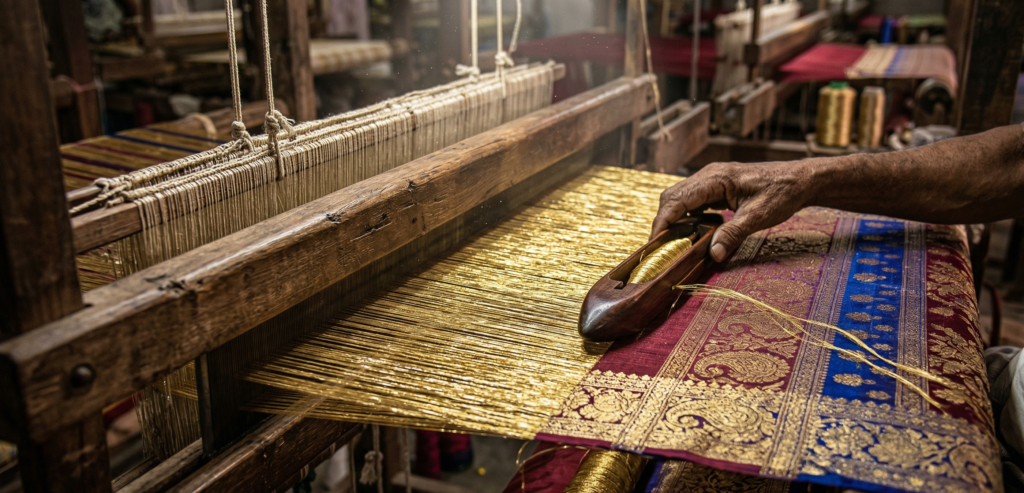
If you’ve ever been to an Indian wedding, you’ve been in the presence of Banarasi silk — even if you didn’t know it by name.
Banarasi weaving has a legacy spanning over 2,000 years. The Mughal period was its turning point. When Persian artisans arrived in Varanasi under Emperor Akbar, they brought with them intricate floral motifs, paisley patterns, and the zari technique the art of weaving gold and silver thread directly into silk. What they built in the narrow lanes of the city was not simply beautiful cloth. The metallic thread designs were symbols of status and rank, worn by men in the royal courts long before the saree, as we know it today, even existed.
Over generations, as Mughal patronage shifted and artisan families spread across Varanasi, the fabric moved from the court into something far more personal. Banarasi silk became so integral to Indian culture that it found its way into every bride’s trousseau — a symbol of prosperity, beauty, and grace that has never left.
The paisleys and floral vines that Persian weavers first created for emperors are still being woven in Varanasi today, by families who have been doing this work for five or six generations. A single saree can carry five hundred years of design memory in its zari.
Did You Know: Authentic Banarasi sarees are protected under a Geographical Indication tag, secured in 2009. Only sarees woven in Varanasi and six surrounding districts of Uttar Pradesh can legally carry the name. If you’re buying one, always look for the GI label.
Ajrakh Block Printing — The Cloth of Belonging
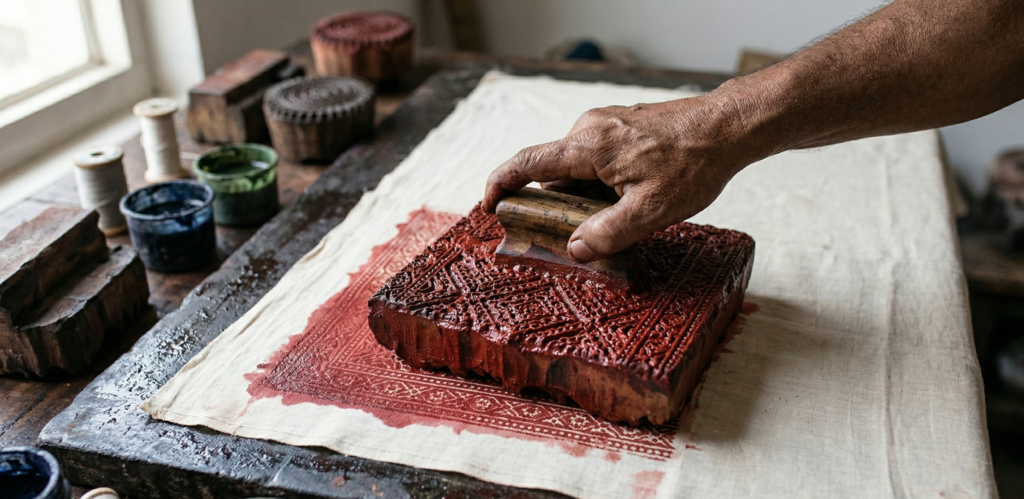
Ajrakh is older than most civilisations still standing.
Its production can be traced all the way back to the Indus Valley civilisation, between 2500 and 1500 BCE. The bust of the Priest King excavated at Mohenjo Daro depicts him wrapped in a shawl with trefoil motifs the same kakar, or cloud motif, that appears in Ajrakh prints being made today. The same geometry worn by rulers nearly four thousand years ago still lives in a contemporary Ajrakh dupatta.
The craft flourished in Sindh and was carried forward by the Khatri community, who migrated into the Kutch region of Gujarat and the Barmer region of Rajasthan, settling near flowing water because water is essential to every stage of the Ajrakh process. The deep indigo and madder red that define Ajrakh come entirely from natural dyes. The geometry is not decorative pattern. It is the visual language of a community, refined over millennia.
In Sindhi tradition, Ajrakh is bestowed upon guests as a mark of honour a gesture that says, simply, you belong here. From birth to marriage, Ajrakh fabrics appear at every significant milestone, used in ceremonies and rituals as a symbol of good fortune and continuity.
Did You Know: Making a single piece of Ajrakh involves up to 16 distinct steps of printing, dyeing, and washing — each layer building the depth and richness of the final pattern. The craft saw a significant revival after the 2001 Gujarat earthquake, when artisan families relocated to a village now known as Ajrakhpur.
Chikankari — The Language of Refinement
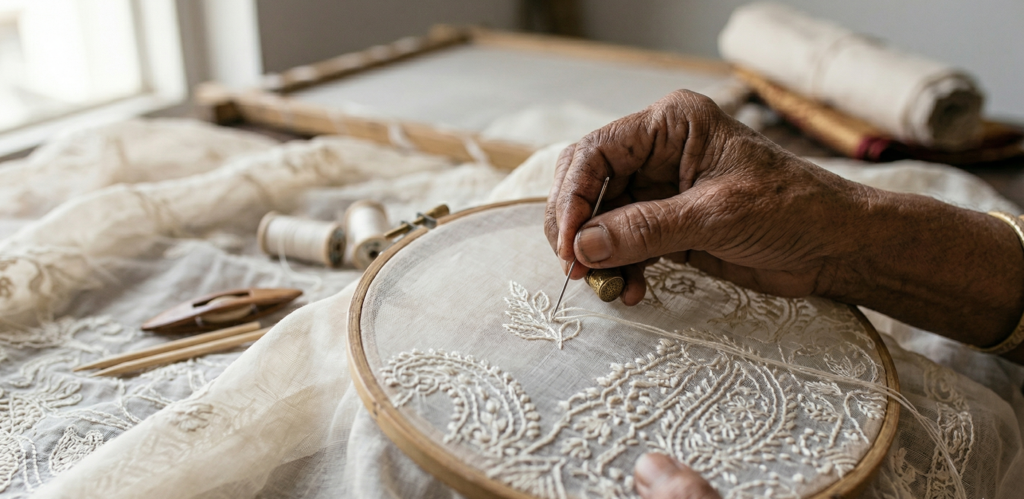
If Banarasi is grandeur and Ajrakh is belonging, Chikankari is something quieter the art of saying everything while appearing to say almost nothing.
Its origins lie in the Mughal era, when Empress Noor Jahan, wife of Emperor Jahangir, is widely credited with bringing Persian embroidery traditions to India. The word chikankari itself derives from the Persian chikan, meaning elegant pattern on fabric. But the craft truly became its own under the Nawabs of Awadh in Lucknow — the city that built an entire culture around the idea of gracious, unhurried refinement.
That culture is called tehzeeb. It is a word that roughly translates to gracious elegance, but carries far more than any translation can hold. Chikankari was its fabric. White thread on white muslin, so fine and delicate it is nearly invisible until the light catches it.
Under the patronage of Nawab Wajid Ali Shah in the 18th century, the craft reached its peak, artisans were trained, their work adorned the wardrobes of nobles and courtiers, and Chikankari eventually found its way into every traditional bridal trousseau as a symbol of purity and grace. Today, Lucknow remains the heart of this craft. Chikankari employs at least thirty different stitches — flat stitches, raised embossed stitches, and jaali work, where threads are carefully drawn apart by hand to create a sheer, lace-like effect. Each stitch has a name. Each name has a history. Every piece, made entirely by hand, is genuinely unrepeatable.
Did You Know: Chikankari received its Geographical Indication status in 2008, officially recognising Lucknow as its exclusive hub. When buying, the difference between hand-embroidered and machine-made Chikankari is visible in the stitching — no two hand-embroidered pieces look identical.
What Connects All Three
Three cities. Three entirely different histories. Three crafts that arrived, independently, at the same place, woven into the fabric of the moments that define a life.
Each one began in a court or a community. Each one moved, over centuries, into the most personal spaces of Indian cultural life – the wedding morning, the ritual gift, the heirloom a grandmother sets aside before she goes. Each one is still being made today, by families who have never stopped.
What we carry forward when we choose these fabrics is not nostalgia. It is continuity a long, quiet conversation between the people who made them and the people who wear them now.
The loom in Varanasi remembers. The block in Kutch remembers. The needle in Lucknow remembers. The question is whether we are paying enough attention to hear what they are saying.
Leave a Reply