
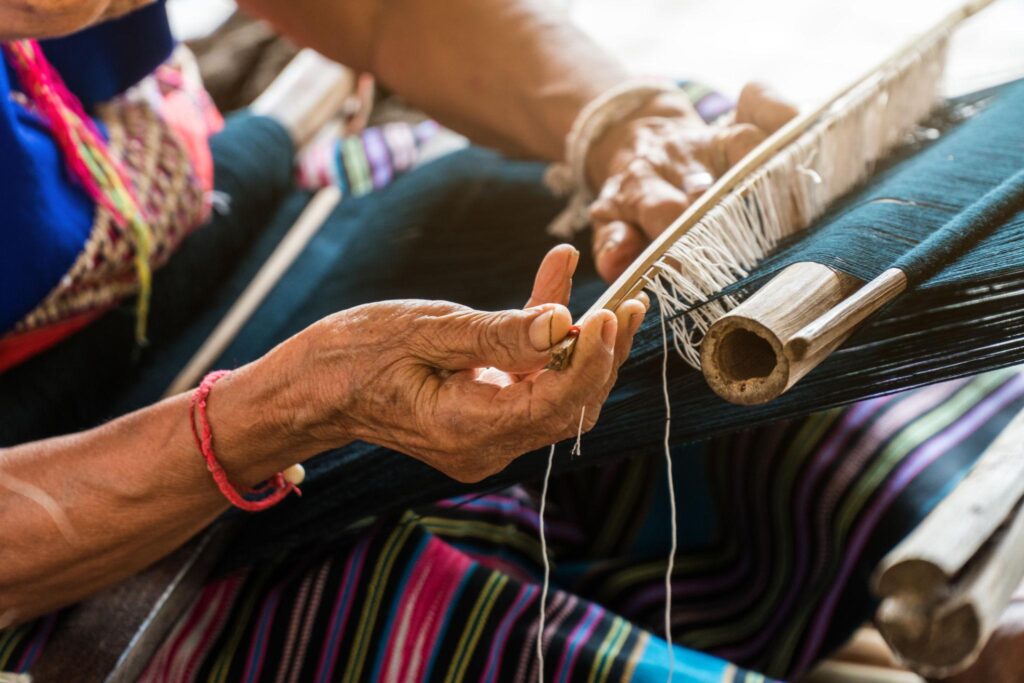
A handloom saree often enters our lives folded neatly on a shelf, draped at a wedding, or passed down through generations. By the time we see it, the story feels complete.
But the most remarkable part happened long before the saree existed.
Long before the first motif appeared. Long before the border found its shape. Long before anyone could call it a saree at all.
Somewhere in a weaving town, the journey began with something far less impressive than finished fabric: a thread.
Not a garment. Not a design. Just a single thread waiting to become part of something larger.
When people search for how a handloom saree is made, they often imagine a weaver sitting at a loom and moving threads back and forth. That image is true, but it tells only a fraction of the story.
The real process begins days earlier.
Before weaving can start, yarn must be prepared, measured, and organized with extraordinary precision. Thousands of threads need to know exactly where they belong before the first weave can even happen.
Imagine trying to build a city where every road must be mapped perfectly before the first brick is laid.
That is what happens on a loom.
The threads are stretched, aligned, and arranged into a framework known as the warp. To an untrained eye, it may look like a collection of lines. To a weaver, it is the blueprint of the entire fabric.
And this is where the first surprise appears.
Many of the design decisions that shape a saree are made before a single inch of cloth is woven.
The colors have already been chosen. The structure has already been planned. The mistakes, if they happen, often happen here.
A small error at this stage can travel through meters of fabric.
Only after this preparation does the loom come alive.
The rhythmic sound of handloom weaving is often described as calming. What is less discussed is the concentration hidden beneath that rhythm.
Every movement matters.
Every thread carries responsibility.
Unlike powerloom production, where machines perform most of the work, handloom weaving depends on constant human judgment. The artisan is not simply operating a tool. The artisan is making hundreds of decisions throughout the day.
How tight should the tension be?
Is the pattern aligning correctly?
Has a thread shifted slightly out of place?
The answers are found not through software or automation, but through experience built over years.
This becomes even more remarkable when patterns enter the picture.
Take a traditional motif woven into a saree border. Most people admire the finished design without realizing that the pattern did not appear all at once.
It emerged thread by thread.
Line by line.
Hour by hour.
What looks effortless in a finished handloom saree often represents days of patient repetition.
Some intricate Indian handloom sarees require weeks to complete. Others take longer. Not because the process is inefficient, but because speed was never the goal.
Accuracy was.
Durability was.
Beauty was.
The handmade textile process in India has always followed a different measure of value. It asks not how quickly something can be produced, but how carefully it can be made.
And perhaps that is what makes handloom different in a world increasingly built around instant results.
A finished saree hides its effort remarkably well.
You do not see the hours spent preparing the warp.
You do not see the adjustments made midway through weaving.
You do not see the generations of knowledge guiding every decision.
You simply see fabric.
Yet hidden within that fabric is a record of time, patience, and human skill that no machine can fully replicate.
The next time you hold a handloom saree, look beyond the pattern.
Somewhere inside those threads is a story that began long before the saree itself.
Leave a Reply