
The Indian wedding season often feels like a race toward the loudest silhouette—a sea of heavy mirrors, synthetic net, and fleeting trends. But there is a quieter, more profound way to stand out. In 2026, the “Informed Guest” is looking toward the longevity of the handloom.
When you choose a heritage weave, you aren’t just selecting an outfit; you are becoming a custodian of a craft. The challenge lies in the translation: how do we make an ancient textile inhabit the modern world without losing its soul? Here is our blueprint for styling heritage using sculptural draping and textile layering.
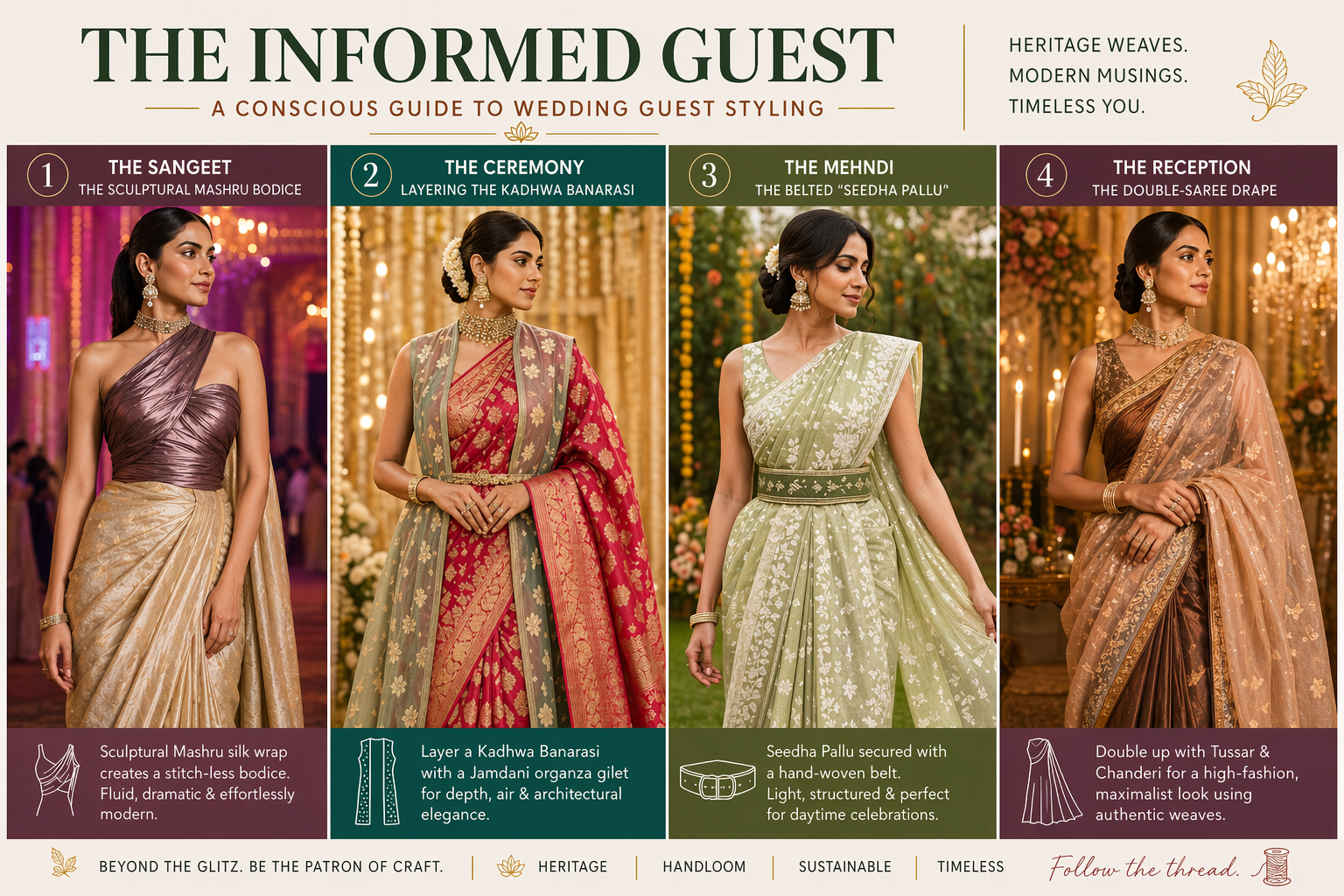
1. The Sangeet: The Scupltural Mashru Bodice
The Sangeet demands fluidity and drama. Instead of a standard blouse, we look to the structure of the fabric itself.
- The Knowledge: Mashru—meaning “permitted” in Arabic—was born from a technical necessity. It features a lush silk face and a cooling cotton backing. It is the original “functional luxury,” designed to be worn against the skin.
- The Modern Translation: Replace the blouse with a sculptural Mashru silk wrap. Use a contrast-colored Mashru yardage to create a pleated, one-shoulder bodice that stays in place without a single stitch. The high-sheen satin finish of the Mashru acts as jewelry, allowing you to move freely through the evening.
2. The Ceremony: Layering the Kadhwa Banarasi
A wedding ceremony is a testament to time, making it the perfect setting for a Banarasi. However, the modern guest can add a visionary edge through textile layering.
- The Knowledge Note: Look for the Kadhwa weave. Unlike the ‘phekwa’ or cutwork technique, Kadhwa motifs are individually hand-tucked into the fabric. If you flip the saree over and see no messy loose threads (floats) between the motifs, you are holding a masterpiece.
- The Modern Translation: Layer your Banarasi with a long, unstitched gilet made of hand-woven Jamdani organza. This creates an architectural silhouette that adds depth and “air” to the heavy silk without hiding the craftsmanship. It turns a traditional drape into a multi-dimensional ensemble.
3. The Mehndi: The Belted “Seedha Pallu” and Hand-Woven Corsetry
Daytime events require a lightness of spirit. This is where the ethereal Dhaka Jamdani excels.
- The Knowledge: Jamdani is a supplementary weft technique where patterns are hand-carved into the fabric using fine bamboo sticks as the loom is in motion. It is “woven air.”
- The Modern Translation: Revive the traditional Seedha Pallu (front drape) but secure it with a hand-woven fabric belt or a wide silk cummerbund. This cinches the waist, turning the delicate Jamdani into a sharp, structured silhouette that feels urgent and relevant for a garden setting.
4. The Reception: The Double-Saree Drape
For the grand finale, we challenge the notion that a saree must be worn alone.
- The Modern Translation: Experiment with the Double-Saree drape. Pair a heavy Tussar silk with a lighter, sheer Chanderi. By draping both together—one as the base and the other as a secondary sculptural pallu—you create a high-fashion, maximalist look using nothing but authentic Indian weaves.
The Power of the Informed Choice
Being a guest is an opportunity to be a patron. When you understand the difference between a hand-tucked motif and a digital print, you don’t just “buy” an outfit—you invest in a community. This season, don’t just follow the trend. Follow the thread.
Leave a Reply